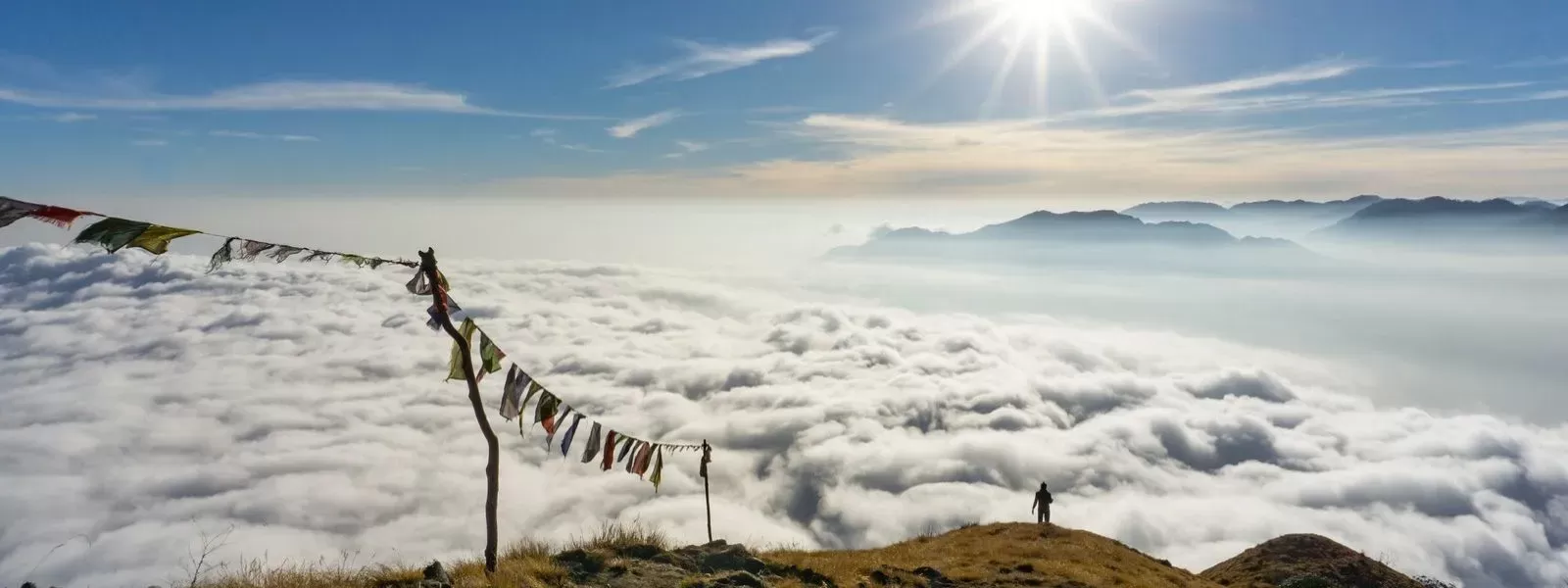







If you looking for the shortest trek in the Annapurna Range, the Mardi Himal trek can be one of the best options. The trail takes you all the way to 4,350 meters at Mardi Himal Base Camp (with upper viewpoints reaching up to 4,500 meters). Despite reaching these high alpine elevations, the trip can easily be completed in 4 to 8 days. This trek is ideal for travellers who want maximum Himalayan scenery without spending weeks on the trail or committing to extreme mountaineering.
First opened as an official teahouse trekking route in 2012, the trail has rapidly grown in popularity. The trail was initially popular among domestic Nepali hikers. The unique geography of the trail gained popularity among international adventurers within a short time. While classic Himalayan treks follow deep river valleys, the Mardi Himal route ascends along a towering mountain spine that divides the Mardi Khola and Modi Khola valleys.
Book the trip to experience the dramatic peak of Mount Machhapuchhre (commonly known as Mount Fishtail, 6,993 meters) and Mardi Himal itself (5,587 meters).
The Mardi Himal Trek is officially rated as Moderate (Grade 3) in difficulty. You do not require any technical climbing skills, ropes, ice axes, or prior mountaineering experience. However, "moderate" in the Himalayas should not be mistaken for a casual walk in a city park. You need to have basic physical fitness in order to complete the trek.
Because the entire route sits inside the Annapurna Conservation Area, checkpoints are stationed along the trail to inspect your paperwork.
If you are not planning to purchase a whole trekking package, but need a guide service, we are there for you. Having an experienced, government-licensed guide is the single best investment you can make for a safe, stress-free, and memorable trek to Mardi Himal.
Taking a guide service will benefit you in two ways, you will
NOTE: Taking a guide service is only recommended if you are flexible to deal with the hotels and accommodations on your own. Your guide will assist you in every way, but, if you want hassle free trekking, taking a package is highly recommended.
You will take a tourist bus ride from Kathmandu to the lakeside city of Pokhara early in the morning. The route follows the Trishuli and Marshyangdi rivers, passing hillside farmlands, cities, and small rural towns. Upon arriving in Pokhara, you will check into your hotel and enjoy a very relaxing evening walking along the Phewa Lake with a view of Mount Machhapuchhre in the distance.
After an early morning breakfast, you will take a drive along the Baglung Highway to Kande. Kande is the starting point of your Mardi Base Camp trek. The trek is mostly uphill along stone steps through cool forested paths toward Australian Camp (Thulo Kharka). Australian Camp offers wide panoramic views of the Annapurna and Manaslu ranges. We will take a brief rest to soak in the environment and end with having lunch and continue along a gradual forest ridge trail Pitam Deurali. Overnight stay at a teahouse in Pitam Deurali.
You will leave the main trail behind that leads toward Annapurna Base Camp. Entering a dense, ancient forest dominated by giant rhododendron, hemlock, and other trees, you pass right through the secluded Mardi Himal ridge trail.
After approximately 3-4 hours of climbing through the shade, you reach Forest Camp where you will stop for lunch. After lunch, the ascent continues and you start to gain altitude. You will get your first thrilling close-up views of Mount Machhapuchhre today in Low Camp. Overnight at a teahouse in Low Camp.
This day the trek will be short, yet dramatic as you will leave the forests and get introduced to the alpine zone. You will reach Badal Danda (3,210m) in an hour of the trek. This danda is a very famous ridge-top vantage point whose name translates to "Cloud Ridge”. The views from Badal Danda offer you a 360-degree panorama of Annapurna South, Hiunchuli, and the needle peak of Machhapuchhre right ahead.
The trail climbs steadily toward High Camp (3,6000m). You need to minimize your pace and take care of your health from now on. The air starts to thin and you become more prone to altitude sickness. Overnight at a teahouse in High Camp.
You will have to wake up super early, around 3:30 AM today. Bundled in warm clothes, and equipped with headlamps, you set off into the cold, and starry night toward Upper View Point. The hike up takes around 2 hours, the reason why you need to wake up super early in order to see the sunrise.
This is the best day of your whole trek as you see the sun rise, illuminating the giant south face of Annapurna I (8,091m), Annapurna South, Hiunchuli, and Machhapuchhre standing directly in front of you. For those feeling strong and well-acclimatized, an additional 1.5-hour hike can be done to reach Mardi Himal Base Camp (4,500m) at the base of the summit wall. After capturing photos and taking your time, you trek down to High Camp for a hot breakfast.
You trek back the same route, all the way to Low Camp via Badal Danda. Depending whether you hiked to base camp or on your group's pace, you either stay overnight at Low Camp or trek straight down to the traditional village of Siding.
If you spent night 5 at Low Camp, you will have to trek down 2-3 hours to Siding following bamboo forests. Siding is a quiet, authentic Gurung settlement away from commercial tourist hubs, highlighting a traditional rural life, terraced rice paddies, and stone-built farmhouses.
At Sidhing, you will take a private jeep and drive all the way to Pokhara. You will reach Pokhara in the afternoon, giving you a time to go out and enjoy the evening and night beauty of the city.
The Mardi Himal Trek can be done almost year-round, but weather conditions vary dramatically across seasons. These two primary peak seasons offer the clearest views and most favorable weather conditions.
Acute Mountain Sickness (AMS) can affect anyone above 2,500 meters, regardless of age or physical fitness. Because Mardi Himal ascends rapidly from 1,770m to 4,500m in 3 days, proper precaution is crucial.
Mardi Himal does not require technical mountaineering skills. However, preparing your body 4 to 6 weeks before your trip is highly recommended in order to complete the trek enjoying it.
You can add regular aerobic exercise into your routine like running, swimming, cycling, or stair climbing. If you have any spots nearby, you can also take a light backpack and go on a hike. This will build muscle memory in your calves, knees, and ankles. Mental preparation for living in simple teahouses that feels like a local home is equally valuable.
Teahouses along the Mardi Himal trail serve fresh, wholesome, and delicious meals cooked daily in family kitchens. The menu is mostly designed to keep you fueled and warm.
Getting to and from the Mardi Himal trailhead is simple:
Takes 1 to 1.5-hour drive in a comfortable private car, taxi, or jeep.
Takes 1.5 to 2-hour drive over unpaved country roads in a sturdy 4WD local jeep.
Local mobile network SIM cards from NTC and Ncell provide reliable cellular signal and 4G data around Pokhara, Kande, Pothana, and Deurali. However, signal reception becomes weak or intermittent past Low Camp and High Camp along the exposed high ridge.
Most teahouses offer Wi-Fi access for a nominal fee of $1 to $3 USD per device, though connectivity can slow down during windy or cloudy weather. Trekking guides carry local cell phones and maintain daily communication with head offices for emergency support.
Booking your trip with Hidden Trek Nepal is fast, secure, and straightforward:
It is possible to obtain a visa on arrival for individuals from the majority of countries by visiting the online website of the Immigration Department of Nepal. Online forms must be filled out, printed, and brought with you.
The online system can be accessed at https://nepaliport.immigration.gov.np/ from any location and at any time. The Online Application System can keep your application for 15 days in its system, allowing you to apply at your convenience and present it to the Immigration Authority at the time of admission or visa extension.
Visas on arrival are valid for 15, 30, or 3 months and are priced at:
Requirements: Original passport (valid for at least 6 months), completed visa application form (via airport electronic kiosks), and cash in USD.
Citizens of SAARC countries (including India) receive free or discounted visa processing under official regional regulations.
We recommend you to participate in a one day hike before the Mardi Himal trek. This greatly helps your body adjust to higher elevations. You will also get a chance to test your gear and break in your hiking boots on these short walks to find and correct any problems while still near city shops and resources. Some suggestions for hiking places near Kathmandu are: Champa Devi Hiking, Jamacho (Nagarjun Hill) Hiking, Sundarijal Hiking, Chandragiri Hiking,etc.
If you have missed some gears, you can also do gear shopping in Thamel. Thamel is the ultimate gear hub! You can buy or rent down jackets, sleeping bags, dry sacks, trekking poles, and thermal layers.
Most importantly, make time to meet your trek leader to review route details, double-check gear, and pack your complimentary duffel bag.
If you have extra time available you can visit some very popular cultural locations that carry histories while in Kathmandu. You may wander around: Boudhanath (Boudha), the Monkey Temple (Swayambhunath Temple), Pashupatinath Temple, and three Durbar Squares (Kathmandu, Lalitpur, and Bhaktapur).
After the Mardi Himal Trek, relaxing and enjoying the splendor of Nepal is worth it. We recommend:
Choosing Hidden Trek Nepal ensures you are not just another tourist, but a valued guest in our homeland.
The highest point reached on the trek is Mardi Himal Base Camp (4,500m). The highest overnight sleeping spot is High Camp at (3,580m).
Yes! The Mardi Himal Trek is one of the best choices for beginners in Nepal. The trails are well-marked, daily walking hours are manageable (4 to 7 hours), and teahouses are located every few hours. Basic physical fitness and a steady pace are all you need.
On average, daily walking durations range between 4 and 7 hours, depending on terrain gradient and altitude gain.
Yes! You will get to see a clear view of the whole Annapurna range peaks.
Mardi Himal trek is famous for a short, family-friendly trek. If you are a beginner, this may be the best tek for you as the route has teahouses available in every few hours.