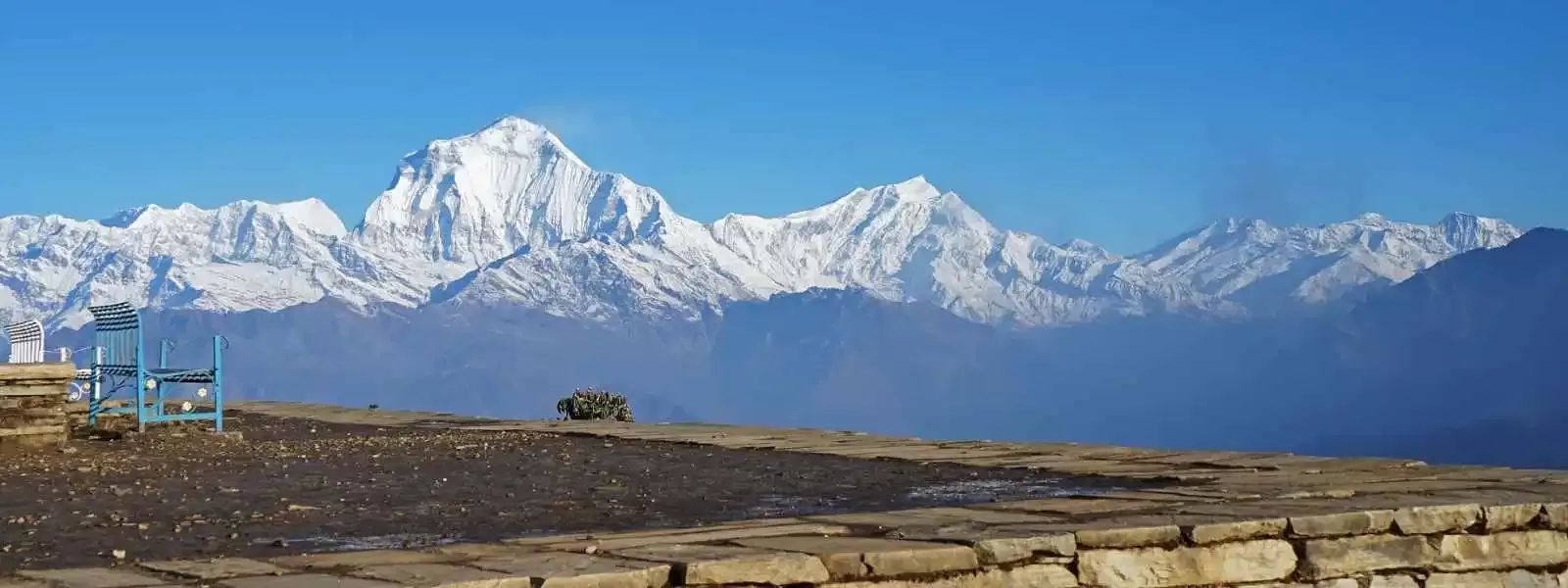






The beautiful off the beaten trekking route of Khopra Danda is located in the Annapurna region of western Nepal, within the Annapurna Conservation Area (ACA). The route shares the same mountain landscape of ABC trek, but they are two different trekking destinations with different routes.
Khopra Danda trek is famous for its panoramic views of the Annapurna and Dhaulagiri mountain ranges, traditional villages, rhododendron forests, and peaceful trails. The route is generally less crowded than the Annapurna Base Camp and Ghorepani Poon Hill routes.
This Khopra Danda trek is a 8-day journey, and is one of the few routes in the region that still feels wild and peaceful. The trail climbs through thick rhododendron and oak forests, crosses small Gurung and Magar villages, and rises to Khopra Danda (3,660m). Khopra Danda is also popularly called Khopra Ridge.
Quick facts:
Short Answer: Rated overall as a moderate trek, the trail is not technical, but not much easy either.
Khopra Danda trek maintains a sweet balance as an accessibility for first time trekkers and a hidden trail option for high altitude trekkers. You don’t need a high skill experience, but steady legs with a bit of preparation is required. Some trails include stairs and uphill stretches with 5- 7 hours of walking. However, you don’t need to sleep above 3,660m, which does decrease your chance of getting altitude sickness.
You can join gym or walk regularly prior six months of your trekking and hike/climb stairs during the weekend. The altitude and physical requirement of Khopra Danda trek is much gentler than Everest Base Camp and Annapurna Base Camp.
Visitors who have done Khopra Danda Trek call it "easy" for a few good reasons:
Most of all, Khopra Danda trekking provides you a giant himalayan view without needing a big mountain body. That is why Hidden Trek Nepal recommends it for beginners who want something beyond the popular Poon Hill trek.
Easy does not mean effortless. Here is what can test you:
However, good boots, trekking poles and a slow pace solve most of these problems.
Permit fees and rules are set by the government, so always double-check the latest permit updates and prices with your operator.
|
Permit Type |
Cost |
Purpose |
|
Annapurna Conservation Area Permit (ACAP) |
NPR 3,000 ($22-$30 USD) |
Conservation and trail management |
|
NPR 1,000 for SAARC nationals |
||
|
Trekkers' Information Management System (TIMS) Card |
NPR 2,000 ($15-$20 USD) |
Official safety registration and checkpoint tracking |
The TIMS card was recently removed as a requirement for the Annapurna region, so many operators no longer collect it.
If you are not planning to purchase a whole trekking package, but need a guide service, we are there for you. Having an experienced, government-licensed guide is the single best investment you can make for a safe, stress-free, and memorable trek to Khopra Danda.
Taking a guide service will benefit you in two ways, you will
NOTE: Taking a guide service is only recommended if you are flexible to deal with the hotels and accommodations on your own. Your guide will assist you in every way, but, if you want hassle free trekking, taking a package is highly recommended.
Rules in Nepal can change quickly, so our team shall confirm the latest requirement before your trip.
You will take a tourist bus ride from Kathmandu to the lakeside city of Pokhara early in the morning. The route follows the Trishuli and Marshyangdi rivers, passing hillside farmlands, cities, and small rural towns. Upon arriving in Pokhara, you will check into your hotel and enjoy a very relaxing evening walking along the Phewa Lake with a view of Mount Machhapuchhre in the distance.
After breakfast, you leave Pokhara by jeep and drive to Ghandruk. The road is bumpy but scenic, leading you to a large and lively Gurung village. From Ghandruk, you start walking uphill through stone steps and forests of oak and rhododendron all the way through Tadapani. Tadapani is a small settlement in the middle of the forest. On a clear evening you may see Annapurna South and Fishtail (Machhapuchhre) turning golden. Overnight at a hotel in Tadapani.
Today will be a long day, climbing through deep forest, passing the Dobato area, and keep heading upward on a ridge trail. The views open up slowly, and the air gets cooler. Bayeli Kharka is a quiet high-pasture spot with only a few lodges with a peaceful setting. Wear warm clothes as soon as you arrive, because the temperature drops after sunset. Overnight at a hotel in Bayeli Kharka.
The trail climbs steadily through open land, ridge appears, and so do the mountains. Today the trek will be less strenuous. You reach Khopra Danda where a community lodge sits on a windy hill with a front-row view of the Annapurna and Dhaulagiri ranges. Spend the afternoon resting, taking photos and watching the clouds move. Sunset here is the kind that makes people go quiet. Overnight at the hotel in Khopra Danda Ridge.
The downhill starts from today, leaving the high mountains and heading toward warmer land. The trail passes forests and small settlements before reaching Swanta, a beautiful traditional village known for its calm village life. Overnight at the hotel in Swanta.
You begin a steady uphill climb through green forests all the way to Chitre. Chitre is the rejoining section of the main trekking trail to Ghorepani. A final uphill takes you to the beautiful village Ghorepani, a busy village where trails from many directions meet. The village is the stopping point of major Annapurna trekking region teks. The ambience will be lively with various tourists who have trekked / about to trek various destinations. Overnight at the hotel in Ghorepani.
You wake up super early and hike through the stone staircase for about 45 minutes to Poon Hill for the best sunrise view. As the first light touches the peaks, golden light illuminates a 180-degree panorama including Dhaulagiri, Annapurna I, Annapurna South, and Machhapuchhre.
You return back to your hotel, have breakfast, and begin the long descent through Ulleri and its famous stone staircase down to Birethanti. From there, a private vehicle takes you to Pokhara, ending the beautiful 8 days trip. Enjoy your beautiful relaxing in the beautiful city of lakes.
The Khopra Danda Trek can be done almost year-round, but weather conditions vary dramatically across seasons. These two primary peak seasons offer the clearest views and most favorable weather conditions.
Acute Mountain Sickness (AMS) can affect anyone above 2,500 meters, regardless of age or physical fitness. Because Khopra Danda has a sleeping point below 4,000m, the risks are low, however, proper precaution is crucial.
As mentioned earlier, Khopra Danda does not require technical mountaineering skills. However, preparing your body 4 to 6 weeks before your trip is highly recommended in order to complete the trek enjoying it.
You can add regular aerobic exercise into your routine like running, swimming, cycling, or stair climbing. If you have any spots nearby, you can also take a light backpack and go on a hike. This will build muscle memory in your calves, knees, and ankles. Mental preparation for living in simple teahouses that feels like a local home is equally valuable.
Teahouses along the Khopra Danda trail serve fresh, wholesome, and delicious meals cooked daily in family kitchens. The menu is mostly designed to keep you fueled and warm.
The signal is patchy as you start uphilling, they can be weak or missing higher up. Mobile networks from Ncell and Nepal Telecom work in some spots like Ghandruk, Tadapani and Ghorepani.
Most lodges offer Wi-Fi at a small fee, but do not count on it for important calls. Charging phones and power banks usually costs a few hundred rupees per charge. Let family and friends know that you may be out of touch for a few days. Your guide can contact the office or emergency services if needed.
Booking your trip with Hidden Trek Nepal is fast, secure, and straightforward:
It is possible to obtain a visa on arrival for individuals from the majority of countries by visiting the online website of the Immigration Department of Nepal. Online forms must be filled out, printed, and brought with you.
The online system can be accessed at https://nepaliport.immigration.gov.np/ from any location and at any time. The Online Application System can keep your application for 15 days in its system, allowing you to apply at your convenience and present it to the Immigration Authority at the time of admission or visa extension.
Visas on arrival are valid for 15, 30, or 3 months and are priced at:
Requirements: Original passport (valid for at least 6 months), completed visa application form (via airport electronic kiosks), and cash in USD.
Citizens of SAARC countries (including India) receive free or discounted visa processing under official regional regulations.
If you have missed some gears, you can also do gear shopping in Thamel. Thamel is the ultimate gear hub! You can buy or rent down jackets, sleeping bags, dry sacks, trekking poles, and thermal layers.
Most importantly, make time to meet your trek leader to review route details, double-check gear, and pack your complimentary duffel bag.
If you have extra time available you can visit some very popular cultural locations that carry histories while in Kathmandu. You may wander around: Boudhanath (Boudha), the Monkey Temple (Swayambhunath Temple), Pashupatinath Temple, and three Durbar Squares (Kathmandu, Lalitpur, and Bhaktapur).
After the Khopra Danda Trek, relaxing and enjoying the splendor of Nepal is worth it. We recommend:
Choosing Hidden Trek Nepal ensures you are not just another tourist, but a valued guest in our homeland.
Yes. It is a moderate trek with a gentle altitude profile. If you are reasonably fit and prepared to walk 6 to 7 hours a day, the trek is best for you.
The classic route takes 7 days from Pokhara to Pokhara. Shorter and longer versions are also possible. You can also extend your trek to ABC, Mardi Himal etc.
Khopra Danda is about 3,660m above sea level. However, the Khayer Lake takes you to 4,660m.
Most lodges have solar power for lighting and paid charging. Wi-Fi is available in some places, but it can be slow.
Nepal is generally safe for female trekkers, and with a trusted guide the trek is very comfortable. You will find many women during the trek.
Depending on your condition, your guide may suggest you to rest in the trail for a day and continue the trek if your health gets stable. During serious cases, a helicopter can be arranged. This is why insurance with evacuation cover is a must.
Yes. Many people add the Mohare Danda route, Annapurna Base Camp, Mardi Himal or a few relaxing days in Pokhara.
No. The hike to Khayer Lake is completely optional. If you feel tired or prefer not to tackle the long high-altitude hike, you can relax at the Khopra Ridge lodge. You don’t need to cross the lake in order to return back.
Yes. Travel insurance is mandatory for all foreign trekkers in Nepal. Your policy must explicitly cover high-altitude trekking up to 4,700 meters, emergency medical expenses, and helicopter evacuation.